October 23, 2026
Have you been refused a Schengen visa while applying from UK? Are you worried about how to reapply or whether you should choose the jurisdiction process?
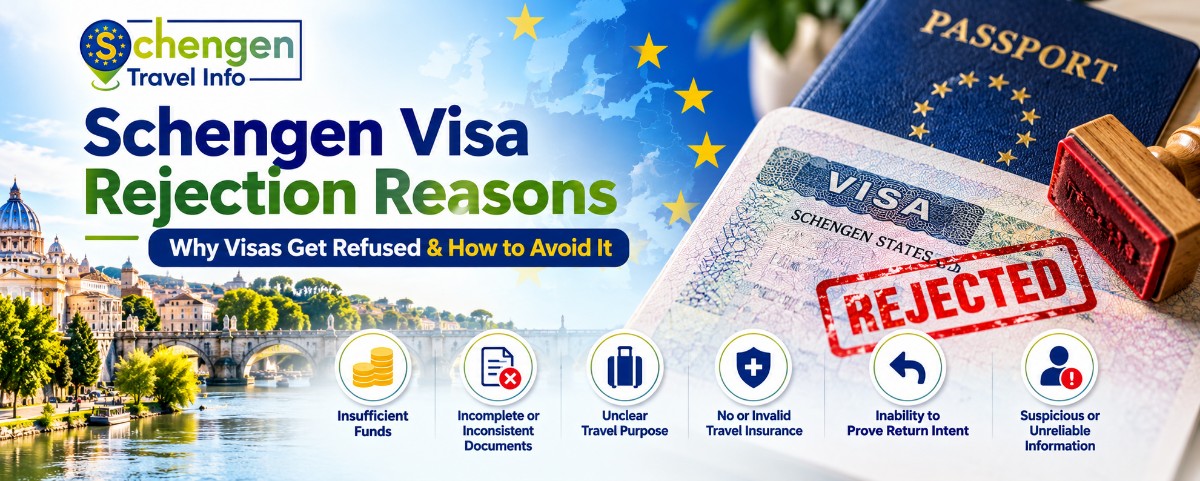
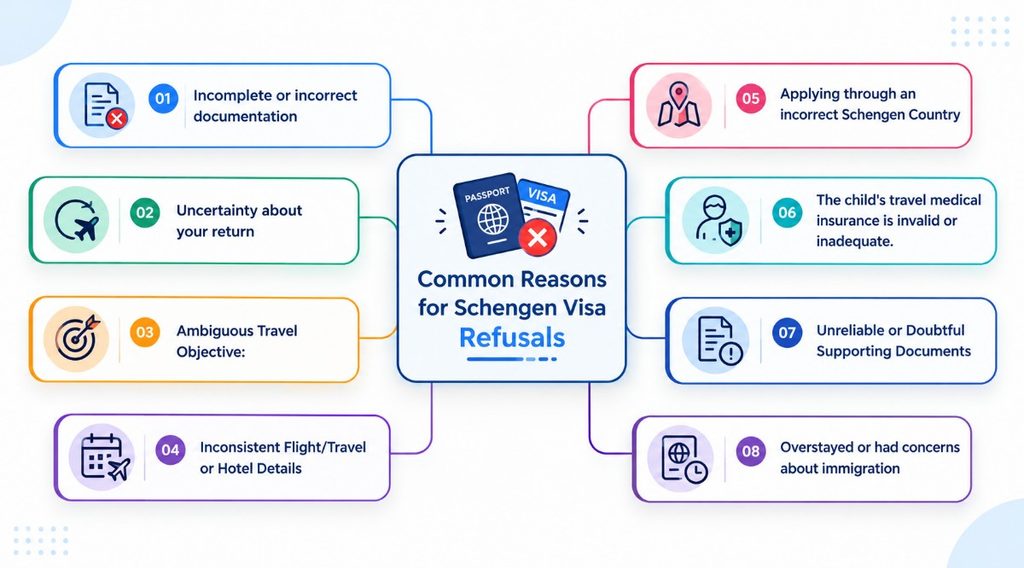
Some of the most common reasons for Schengen visa rejection include incorrect documentation, false information, insufficient financial funds, lack of valid medical insurance, unclear purpose of visit, and a criminal history.
This guide explains the common Schengen Visa Rejection Reasons applicants face. To have a successful Schengen visa application, you must ensure that you submit the correct documentation, obtain valid medical insurance, have sufficient funds, with a clear intention of visiting the country, among other factors.
Quick Answer: Most Schengen visa refusals come down to four things: unconvincing finances, no proof you’ll return, an unclear purpose or bookings, or missing documents. The fix is a tidy, consistent file before you apply.
Understanding the reasons can be the biggest answer to “How to avoid Schengen visa rejection”.
Navigating this is the first step towards preparing a more complete and convincing application.
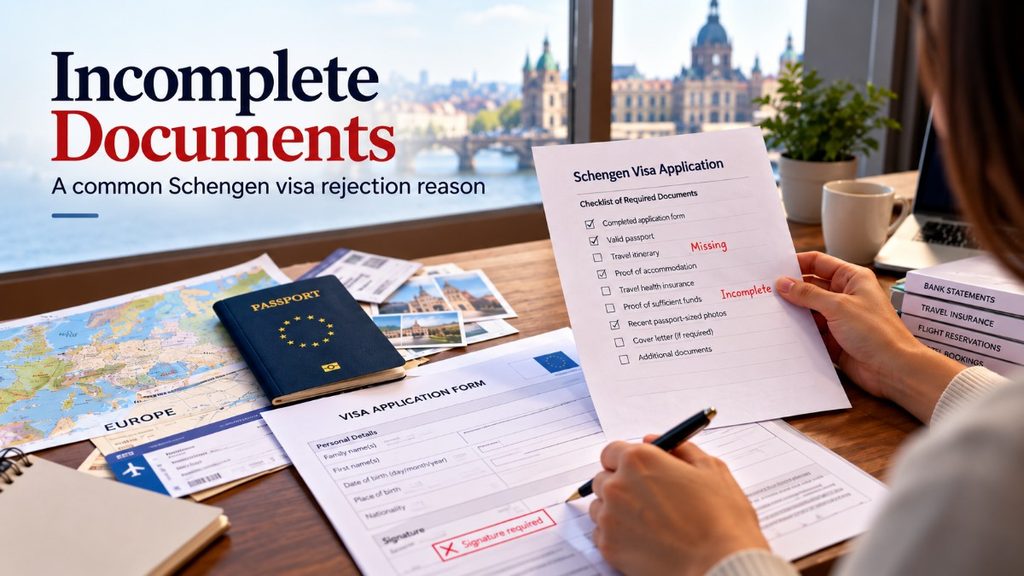
Visa centre authorities may find it challenging to determine your eligibility if there are missing documents or inconsistencies.
One such instance is that the travel dates on your visa application could be different from your hotel booking. Your leave request may be for different dates than your employer’s, or your leave documentation may not include who will be covering your expenses.
The following are some common documentation errors:
To prevent this rejection reason:
The criteria for a short-stay Schengen visa are based on the purpose of the stay and the intention to leave the Schengen Area prior to the end of the visa’s validity.
Another Schengen visa refusal reasons is reasonable doubt about your plans to return.
The consulate will take your personal situation, employment, financial status, family responsibilities, residence status, and travel history into account when making a decision about your application.’
Some possible concerns might be:
To prevent this rejection reason:
Another reason why was your Schengen visa rejected is your objective for the visit.
Your application will have to specify the reasons for your visit to the Schengen Area and your intended activities there.
Visa authorities might question your trip if your travel plans are not clear, or if supporting documents do not provide sufficient explanation of your travel plans.
To prevent this rejection reason:
A Schengen visa application UK should look as though there’s a coherent travel plan. In case of discrepancy between information provided on the application form and supporting documents, the information provided on the form will be taken with a pinch of salt by the consulate.
How to prevent this:
It’s crucial to select the right country when moving to several Schengen countries.
Generally, you should apply to the country where you want to go as your only destination or, if you intend to visit more than one country, the country where you plan on staying longest. In general, if the length of the visit is the same, you will be sent to the country where you entered first.
You may be required to apply to a country that is not liable for your journey, and as a result, your application may not be accepted or processed by the relevant authority.
To prevent this rejection reason:
Also read: Check out the easiest Schengen visa to get from UK!
Travel medical insurance is one of the conditions for obtaining a regular Schengen visa for short trips. The insurance policy may be denied if it does not meet the requirements, and this is a common Schengen Visa Rejection Reasons.
Potential issues include:
How to prevent this reason for rejection:
It’s not just the quantity of documents that is important, but their credibility too. The visa centre can refuse you a visa if it believes, for a good reason, that a document isn’t authentic or that the information in it is not correct.
This may be related to employment letters, bank statements, reservations, invitations, travel insurance or supporting documents.
To prevent this rejection:
Also read: How long does it take to process the Schengen visa from UK?
A short-stay Schengen Visa from UK will normally allow you to stay for a max of 90 days in every 180-day period, depending on the validity of the visa and the duration of stay allowed by the visa.
Visits must be booked taking into account previous visits. If you do overstay, you may be subject to immigration consequences and may be concerned when applying in the future.
To avoid these Schengen Visa Rejection Reasons:
Note: Go through the detailed guide on Schengen visa application mistakes that UK applicants make!
While applying for a Schengen visa, you must consider important things like application time, appointment rush, and documentation.
Need help submitting the visa form? Start your Schengen visa process from UK with us!
If you faced a rejection recently, then you might be thinking about what to do. In this case, you have two options: reapply or appeal!
Reapply –
Submit a new application if you think that the rejection happened due to incomplete documents or any error in your application. This process is generally faster and much more practical.
Appeal –
This is chosen when the applicant thinks that there is an administrative error and your application is perfect. For submitting the appeal, you must check the bottom of your refusal letter for the deadline.
Finding professional help with this process? Then you can get connected with SCHENGEN TRAVEL INFO, a trusted visa agency based in the UK. They have 15+ years of experience in this field and have immense knowledge in handling Schengen visas.
How they help UK applicants:
In conclusion, this guide tried to help the applicants who are worried about rejection or have faced it recently and are planning to submit the form again. This makes it clear to them what things need to be prepared and what visa authorities seek in an application.
From documentation to application, everything is strictly reviewed at the visa centre, so make sure to know the regulations and not take them lightly. Need professional help? Then you can connect to SCHENGEN TRAVEL INFO. Their guidance can make a huge difference in your application!
As per the rule, the expiration date of your passport is 3 months AFTER your return from the Schengen State. So, before submitting the application, make sure you meet this criterion.
This depends on the type of visa you have been issued – single entry or multiple entry. With a single-entry visa, you can enter the Schengen area only once. This is indicated on the visa sticker by “01”.
With a multiple-entry visa, you can enter the Schengen area multiple times during the visa validity period.
A visa extension is possible only in cases of force majeure, for humanitarian reasons, or for serious personal reasons.
The Schengen area covers 29 countries (“Schengen States”) without border controls between them. These countries are Austria, Belgium, Bulgaria, the Czech Republic, Croatia, Denmark, Estonia, Finland, France, Germany, Greece, Hungary, Iceland, Italy, Latvia, Liechtenstein, Lithuania, Luxembourg, Malta, the Netherlands, Norway, Poland, Portugal, Romania, Slovakia, Slovenia, Spain, Sweden and Switzerland.